
Originally Published June, 2025 on Moving Writers

By this time, we’ve all had it happen. Despite our best efforts, classtime commitment, supervision, and offers of feedback, a student turns in a piece that sounds so remarkably different than the voice we hear in class or their informal writing that one thing is clear: the student has turned in work that is entirely manufactured by artificial intelligence.
This is problematic on so many levels. Most importantly, as Dr. Tony Frontier puts it, when we spot AI cheating, a student has used “a tool or resource to misrepresent [their] knowledge and skill,” ultimately disrupting learning. And extra galling, this creates a burden of proof for teachers, as “the accuser needs to support a claim about cheating with evidence that cheating occurred.
These situations can yank at our emotions, especially if we have seen the student squander class time or opportunities for feedback and opt for the just-before-deadline shortcut, thinking we wouldn’t even clock it. We feel annoyed, disrespected, and maybe even helpless, given the unreliability of AI-checker tools.
So what can we say when this happens? Consider these important related questions:
- How can we draw out a student, get them talking about the “why” behind their actions?
- How can we convey the cumulative effects that unchecked decisions like this will have not just on a single assignment, but on their entire education?
- How can we help them to understand the value of their own voice?
Here are four suggestions that I have found helpful in initiating conversations that not only draw out a confession, but also provoke conversations about student habits, skills, and perceptions that help both of us.
1. “Can you come back at (lunch/study hall/before class tomorrow) to talk about how you went about writing this? I’d like to hear more about your process.”
There is a touch of Hercule Poirot baked into this one. It leaves the student wondering what exactly I know or want to talk about. It communicates that I care about the writing process, and that I have registered something that needs improvement in what they considered a final copy.
It also opens doors not just for conversation about what went wrong, but for demonstration of techniques they might use for inviting AI into their writing process in productive rather than reductive or destructive ways, how it can push them to think rather than replace their thinking.
Many schools are adding some sort of flex time into their daily schedule for intervention and enrichment — at my school it is an hourlong period called “Lunch and Learn” — which gives students and teachers more time for conversations about academic work away from the prying ears of classmates at neighboring desks. This time is helpful as we navigate use of artificial intelligence tools in the classroom.
2. “I don’t really like this. It isn’t very good because it just doesn’t sound like you, and I like hearing from you. Can you try drafting this again? I need to hear your voice in your writing.”
This statement, followed by a request, never makes an accusation. Rather, it clearly states the truth. Their piece is unpalatable to me as a reader (and as their teacher) because it sounds phony.
Brene Brown is well-known for the straightforward line, “Clear is kind.” When I state clearly that I do not really like their finished piece, students often admit that they don’t really like it either, they know it doesn’t sound like them, and that AI generated the work.
Then conversation can turn to what I like about their voice, imperfect as it is, and why their voice matters in their writing. I’ve started using an allusion to The Little Mermaid in these conversations: “Don’t be an Ariel and give up your voice to the sea witch!”
3. “There is some vocabulary in this piece I would like to talk to you about. I would like to hear more about your reasons for choosing the words you chose to express your ideas, like in this part here . . .”
This communicates to students that I am a teacher who reads their entire essays rather than glossing over them. When a student has used AI to write an essay, they are unable to explain their diction and syntax. But not all is lost.
When students feel that AI creates writing that “sounds good” but that we know sounds inauthentic and soulless, it opens an opportunity to ask which words and phrases appeal to them in the AI draft and why. They can learn more about those words and incorporate these snatches of language in their own work more authentically when they draft the piece a second time. In my new book, Artful AI in Writing Instruction, I incorporate this idea as one of the lesson plans in Chapter 4, “Improving Syntax and Diction With AI.”
We can help students use AI’s strength – the quick generation of words – to expand their own capacity for interesting diction and syntax, if we slow them down enough to study and think about the words and then apply them artfully.
4. “Tell me about what you learned through the process of writing this piece. Explain which ideas you feel most excited about.”
This pair of sentences reminds students that writing helps us to learn more about our topic and helps us to feel more excited about it too. When we outsource thinking, there are intellectual costs, according to one recent study from MIT. (We should note here that this is a small study, still awaiting peer review, and research studies on the obvious and hidden costs of AI usage are ongoing). This study showed that the “brain-only” group, composing essays without any AI assistance, “claimed full ownership of their texts almost unanimously” while the “LLM Group presented a fragmented and conflicted sense of authorship.” In other words, overdependence on AI can steal a writer’s sense of agency.
When we open a conversation by asking what students learned and were most excited about, we convey that we expect writerly agency and authorship, and the pride it fosters. Meanwhile, related competencies like emotional intelligence and empathy are increasing in value in workplaces outside of school as skills AI is not replacing. When we remove the emotive aspect of writing by replacing ourselves, when we feel excited about nothing we want to say, we allow a fundamental aspect of what it means to be human to atrophy.
In the classroom, let’s not underestimate the power of having deeper conversations about what it means to learn and to feel, to be human. They are conversations we should have been having all along, and they are extra important now. These two lines can lead us into deeper conversation about why we write in the first place.
The Good News
There are some incredible things we can help kids to know and do using artificial intelligence as part of their writing process. My new book examines some of those. But like cell phones and social media, using this technology requires restraint, and students do not learn that without adults to guide them and explain the reasons behind the rules.
These four lines help us get to the crux of the matter when things go wrong–valuing student voice, listening to student perspectives, and articulating the deeper purposes of the writing we ask students to do–in hopes that the next time, things go right.
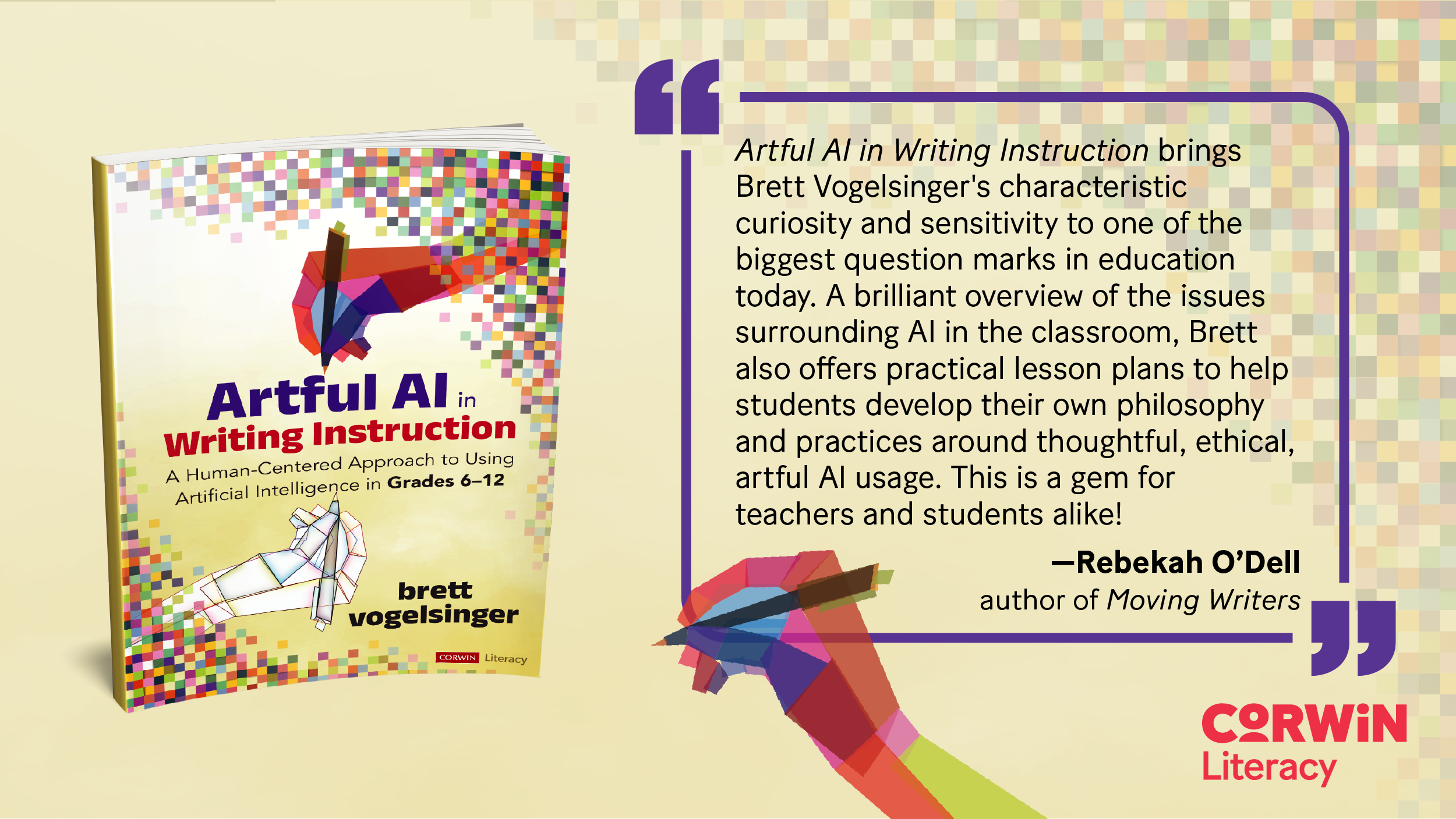
My new book, Artful AI in Writing Instruction: A Human Centered Approach to Using Artificial Intelligence in Grades 6-12 is now available from Corwin Press or on Amazon. My earlier book, Poetry Pauses: Teaching with Poems to Elevate Student Writing in All Genres is also available from Corwin Press or on Amazon. Tell me in the comments if you are already using ideas from either book, or how you plan to in the coming school year! You can connect with me on Bluesky or Instagram @theVogelman, on LinkedIn, or at my website www.brettvogelsinger.com
 Brett Vogelsinger